
How to Increase Rent Legally After May 2026
-
The Section 13 / Form 4A Process
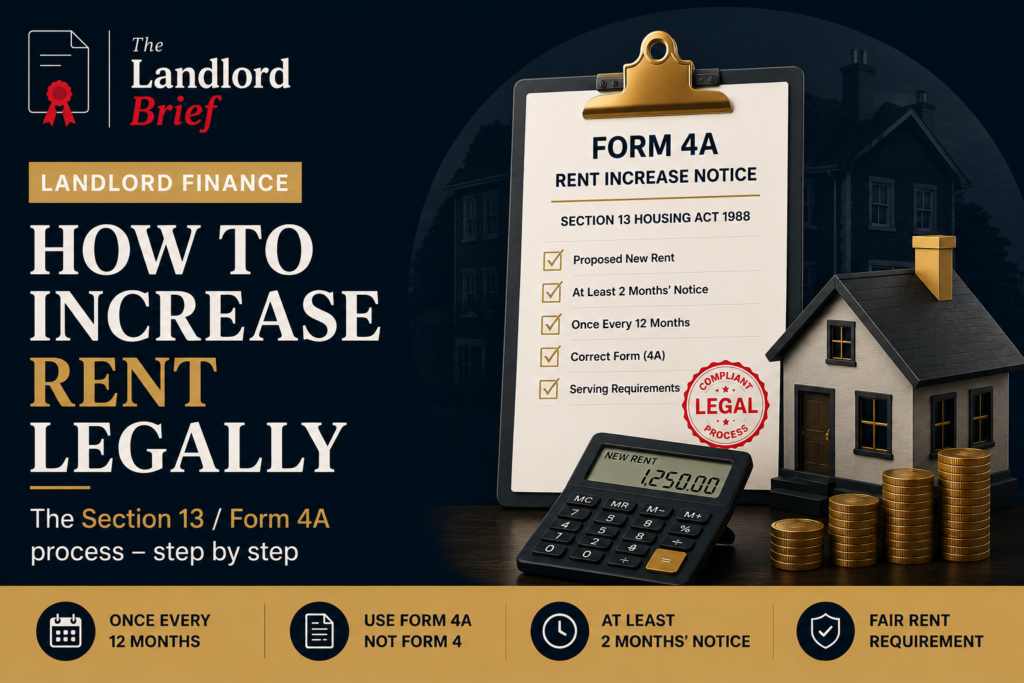
Published: May 2026 | Reading time: 8 minutes | Category: Renters’ Rights Act
From 1st May 2026, there is exactly one legal way to increase your tenant’s rent: Section 13, using the new Form 4A. Rent review clauses in your tenancy agreement become void overnight. Informal agreements with your tenant are no longer valid. Even a handshake deal on a higher rent is unenforceable unless you have first served a Section 13 notice. Get the process right and it is straightforward. Get it wrong and the rent increase does not happen and your tenant may challenge the one that follows too.
For the full plain-English overview of the Act, see The Renters’ Rights Act – The Complete Plain-English Guide for Landlords.
Key takeaways (read this first)
- Section 13 / Form 4A only: From 1st May 2026, no other method of increasing rent is valid. Rent review clauses, informal agreements and renewal increases are all abolished.
- Once per 12 months maximum: You cannot serve a Section 13 notice until at least 52 weeks have passed since the last rent increase took effect.
- Two months’ minimum notice: Double the old one-month requirement. The notice must expire at the end of a rental period.
- No rent cap – but market rate only: There is no government cap on rent levels. But the tribunal will reduce any increase it determines is above open-market rate.
- Tenants can challenge for £47: Any tenant can refer your notice to the First-tier Tribunal for a £47 application fee, with no hearing fee on top of that. Tenants on low incomes may pay nothing at all under the Help with Fees scheme. Factor this into your planning: at £47 with no hearing fee, challenges are low-cost enough that many tenants will use them as a delay tactic regardless of merit.
- Tribunal cannot set rent higher than you proposed: A key protection for landlords. The tribunal determines market rate, but cannot award more than the amount on your Form 4A. Note: if the tribunal finds in the tenant’s favour, it can order the landlord to reimburse the tenant’s £47 application fee.
- Form 4A is live: Download Form 4A now from gov.uk/government/collections/assured-tenancy-forms. Do not use the old Form 4 — it is invalid for any notice served from 1 May 2026 onwards.
Important: This article covers England only
The Section 13 / Form 4A process applies to England only. Scotland, Wales and Northern Ireland operate separate rent increase frameworks. See The Renters’ Rights Act – The Complete Plain-English Guide for Landlords. for the devolved nations overview.
What Changed on 1st May 2026 - and Why It Matters
Before 1st May 2026, landlords had several routes to increase rent: a rent review clause in the tenancy agreement, a mutual written agreement with the tenant, a Section 13 notice, or simply agreeing a new rent at the start of a new fixed term. From 1st May 2026, all of those routes except Section 13 are gone.
Rent review clauses are void from 1st May 2026 – including CPI, RPI and fixed-percentage clauses. It does not matter that they were drafted into the tenancy agreement and were previously enforceable. The Act removes them. If your agreement says ‘rent increases by 3% each year on the anniversary of the tenancy,’ that clause now has no legal effect after the 1st of May.
Informal agreements – where you and your tenant agree a higher rent in writing or verbally, are also no longer valid, unless you have first served a Section 13 notice and the tenant then agrees to a lower amount than proposed. That specific situation is still permitted: you serve a Form 4A proposing £1,200/month, your tenant says £1,100 works for them, and you accept. That is lawful. Agreeing a rent increase from scratch without a Form 4A is not.
TWO THINGS YOU CAN STILL AGREE WITHOUT A FORM 4A
- Accepting a lower rent than proposed: If you serve a Form 4A proposing £1,200 and your tenant negotiates to £1,100, you can accept that without a new form. The Form 4A sets the ceiling, anything below it can be agreed.
- Reducing the rent: You and your tenant can agree to reduce the rent at any time by simple written agreement, no Section 13 notice required. If you want to support a tenant going through financial difficulty by temporarily lowering the rent, a written agreement signed by both parties is all you need. Keep a copy.
The official government guidance on rent increases is at gov.uk/guidance/renting-out-your-property-guidance-for-landlords-and-letting-agents/rent-increases.
WHAT ABOUT INCREASES AGREED BEFORE 1st MAY 2026?
The 52-week clock does not reset on 1 May 2026. If you increased rent using the old Section 13 process in November 2025, your next Section 13 notice cannot take effect until November 2026 at the earliest.
Important – Form 4 tribunal challenges: If a tenant challenges a Form 4 notice served before 1st May 2026, the old tribunal rules apply – the new rent is payable from the date in the notice, not the tribunal’s decision date. The ‘decision date’ rule only applies to Form 4A notices served from 1st May 2026 onwards.
However: any rent increase agreed under a rent review clause before 1st May 2026, but which was due to take effect after 1st May 2026, is not permitted. Government guidance is explicit on this, the clause becomes void on 1st May, and any pending increases under it fall away. If this applies to you, you will need to serve a Form 4A instead. And if a disputed rent history has created confusion about what your tenant actually owes, resolve it before serving any Section 13 notice – a muddled arrears picture complicates both your rent increase and any future Ground 8 claim. See Section 8 Explained for how arrears ground cases work.
Before you continue - download the key landlord deadlines
Takes 30 seconds. Instant download.
The Four Rules You Must Follow Every Time
Rule 1 – Once every 12 months, no more
You can only serve one Section 13 notice per tenancy per 12-month period. Specifically, the new rent cannot take effect until at least 52 weeks have passed since the last Section 13 rent increase came into effect. Not since you served the notice, since the increase actually took effect.
If your tenant challenges the notice at the tribunal and the hearing takes several months, the clock for your next increase does not start until the tribunal makes its determination and the new rent begins. In a worst-case scenario, a contested increase could push your next available increase well beyond 12 months from when you served the notice.
Rule 2 – Two months’ minimum notice
You must give your tenant at least two full months’ written notice before the new rent takes effect. This doubles the old one-month requirement.
The notice must expire at the end of a rental period. Since all tenancies are now monthly periodic, this means the new rent takes effect at the start of the next rental period after the two-month notice expires. In practice: if rent is due on the 1st of each month and you serve the notice on 1 March, the earliest the new rent can apply is 1 June, two full rental periods later.
You can serve the notice up to four months in advance – giving your tenant more notice than the minimum is always permissible and often sensible if you want time to discuss the increase before it lands.
Rule 3 – Market rate only
There is no government cap on how much you can increase rent. You can propose any amount. But the First-tier Tribunal, the independent panel that reviews rent disputes, will not award more than the open-market rent for the property. If you propose a rent above what a comparable property would achieve on the open market, a tenant challenge will result in the tribunal setting it at market rate.
The practical implication: do your research before proposing an increase. Check comparable rentals in your area on Rightmove and Zoopla. If your proposed rent is clearly supported by the market, you are on solid ground. If it is a stretch, a tribunal challenge is likely, and will delay the increase landing by months.
Rule 4 – Use Form 4A, not any other document
You must use the prescribed government form – Form 4A, for every Section 13 notice served on or after 1st May 2026. The old Form 4 is invalid from that date. A letter, email, or even a correctly worded but non-prescribed document does not count. If you do not use Form 4A, the notice is invalid and the rent increase does not happen.
Form 4A is published on GOV.UK. Download it from gov.uk/government/collections/assured-tenancy-forms. Save the downloaded version and date-stamp your file so you know which version you used.
How to Complete and Serve Form 4A - Step by Step
What goes on the form?
Form 4A requires the following information. Have it ready before you start:
Field
What to enter
Tenant name(s)
Every adult named on the tenancy agreement, spelled exactly as on the agreement. One letter wrong can invalidate the notice.
Property address
Full address with postcode, exactly as it appears on the tenancy agreement.
Current rent
The amount currently payable – not including any outstanding arrears.
Proposed new rent
The amount you are proposing from the increase date. Must be higher than current rent (you cannot use Section 13 to reduce rent).
New rent start date
Must be the first day of a rental period, and must be at least 2 months after the date you serve the notice. Must also be at least 52 weeks after the last Section 13 increase took effect.
Landlord signature
You (or all joint landlords) must sign and date the form. A letting agent can sign on your behalf if authorised in writing.
How to serve it
- Post: First-class post is valid. For evidence of service, use recorded delivery or obtain a free certificate of posting at any Post Office counter.
- Email: Valid if the tenancy agreement or prior correspondence makes clear that email is an agreed communication method. Keep the sent email.
- Hand delivery: Ask the tenant to sign a brief receipt confirming delivery date. If they refuse, a witness to the delivery is your fallback.
- Via letting agent: Get written confirmation from the agent that service has been completed, with the date and method.
Keep proof of service in every case. If the tenant claims they never received the notice, you need to demonstrate they did – or your increase is unenforceable.
If Your Tenant Challenges the Increase - What Actually Happens
From 1st May 2026, any tenant can refer a Section 13 notice to the First-tier Tribunal for a £47 application fee, simply by applying before the proposed start date of the new rent. There is no hearing fee on top of that, so the total cost to challenge is £47, making it one of the lowest fees across HMCTS. Tenants who cannot afford this may pay nothing at all under the government’s Help with Fees scheme. They do not need to prove the increase is unreasonable to make the application, they just need to apply.
Industry research from Goodlord’s State of the Letting Industry 2025 report found that around 1 in 5 tenants planned to challenge rent increases regardless of whether they considered the increase fair, simply to delay the increase. At £47 with no hearing fee, that calculation has not changed significantly. Further polling by Generation Rent found that nine in ten tenants would challenge a steep increase if tribunals were free, falling to around half if the fee were £200. At £47, the real-world deterrent effect is limited. This is not a hypothetical risk. Factor it into your planning.
What the tribunal does
The tribunal sets the increase at open-market rent – what a comparable property would achieve if newly advertised today. It cannot set the rent higher than the amount you proposed on the Form 4A. So if your proposed increase is at or below market rate, a tribunal challenge costs you time but cannot cost you money.
The new rent applies from the tribunal’s decision date, not from the date in your notice. This is the key reason why challenges are low-risk for tenants: even if the tribunal agrees with you entirely, the tenant has gained several months at the lower rent while proceedings ran. One further point landlords often miss: if the tribunal finds in the tenant’s favour – that is, it sets the rent below your proposed figure, it can order you to reimburse the tenant’s £47 application fee. A tribunal challenge you lose therefore costs you the income gap, the delay, and the filing fee.
In cases of exceptional hardship, the tribunal has the power to defer the start of the new rent by a further two months after its decision. This is at the tribunal’s discretion and requires the tenant to demonstrate undue hardship, it is not automatic.
How to protect yourself against a challenge
PREPARING FOR A TRIBUNAL-PROOF SECTION 13 NOTICE
- Research comparable rents before serving. Search Rightmove and Zoopla for similar properties in the same postcode. Screenshot and date the results. If your proposed rent is clearly in line with the market, the tribunal will confirm it.
- Keep a record of your costs. Mortgage rate increases, maintenance costs, insurance, and service charges all support a case for a rent increase – though the tribunal’s test is market rate, not your costs.
- Note demand at the property. How many serious enquiries did you receive at the last letting? Evidence of demand supports your proposed rent as a market rate.
- Serve the notice with a covering letter. Explain how you calculated the proposed rent. A landlord who can show their workings looks more credible at tribunal than one who cannot.
- Do not propose above market. A tribunal challenge you win still delays your increase by months. A challenge you lose, where the tribunal reduces your proposed amount, sets your rent lower than you intended for the next 12 months.
The Mistakes That Make a Section 13 Notice Invalid
These are the errors that make landlords have to start the whole process again, sometimes losing months of a potential increase in the process.
Common mistake
Consequence
Serving before 52 weeks have elapsed
The notice is invalid from the outset. Check the exact date the last increase took effect – not when you served the previous notice.
Notice period too short
Two full months is the minimum. If you serve on 15 March with an increase date of 1st May, that is less than two months. The notice fails.
Increase date not at start of rental period
The new rent must begin on the first day of a rental period. If rent is due on the 1st, the increase date must be the 1st.
Wrong tenant names
Must match the tenancy agreement exactly. A misspelling, or omitting a joint tenant, invalidates the notice.
Using old Form 4 after 1st May 2026
Form 4 is invalid from 1st May 2026. Form 4A is the only prescribed form. Using the old form means no valid notice.
Unsigned form
All joint landlords must sign, or a written authorisation must exist for one to sign for both.
Serving by email with no prior agreement
If email is not an established communication method in the tenancy, serving by email may not constitute valid service.
Proposing a rent reduction via Section 13
Section 13 can only be used to increase rent. To reduce rent, agree it with your tenant by a simple written agreement signed by both parties, no form needed.
Timing Your Increase - A Practical Strategy
Because the tribunal challenge system delays increases, and because a challenge resets the 52-week clock from the tribunal’s decision date rather than your notice date, timing matters more than it used to. All tenancies are now periodic, rolling month-to-month, which means the increase date must always fall at the start of a rental period, so choosing your timing carefully is essential.
Serve as early in your 12-month window as possible
You can serve a Section 13 notice up to four months in advance of the proposed increase date. Serving early gives you more room. If the tenant challenges and the tribunal takes 3–4 months to determine, your increase still lands within a reasonable timeframe. If you serve at the last possible moment, a challenge could push the increase back well beyond 12 months from your last increase.
Do not skip a year – inflation compounds
Some landlords feel awkward raising rent annually and leave it for two or three years. The result: a much larger increase is needed to catch up with the market, which is both harder for the tenant to absorb and more likely to trigger a tribunal challenge. Regular, modest, market-rate increases are easier for everyone. If Scotland’s experience after its own rent reform is anything to go by, suppressed in-tenancy rents lead to large jumps between tenancies as landlords reset to market rates at void periods.
What about new tenancies – can you set the rent at whatever you like?
Yes, when a new tenancy starts, you set the rent at whatever the market supports. There is no cap on initial rents. However, from 1st May 2026 tenants can challenge the initial rent at the First-tier Tribunal within the first six months of a tenancy if they believe it is above open-market rate. The test is explicit: is this the rent a comparable property in a similar condition would achieve if newly advertised today? It is the same test the tribunal applies to Section 13 challenges. Keep evidence that supports your initial rent, comparable listings at the time of letting, the level of demand at viewing, and the number of serious applicants, in case this is ever questioned. The more evidence you have that the rent was the going rate, the cleaner your position.
YOUR ACTION LIST - DO THESE IN ORDER
- Check when your last rent increase took effect, not when you served the previous notice, but when the new rent actually started. Your next Section 13 notice cannot take effect until 52 weeks after that date.
- Check whether you have any rent review clauses in your tenancy agreements. They are void from 1st May 2026, even well-drafted CPI or RPI clauses. Make a note of every property where you were relying on one.
- If a rent review clause increase was due to take effect after 1st May 2026, it will not be valid. You will need to serve a Form 4A instead. Identify any affected properties now and plan the Section 13 notice accordingly.
- Download Form 4A from GOV.UK now – gov.uk/government/collections/assured-tenancy-forms. It is live. Do not use old Form 4 for any notice served from 1st May 2026 onwards.
- Before proposing a rent increase, research comparable rents on Rightmove and Zoopla. Screenshot and date the results. This is your evidence if a tenant challenges at tribunal.
- Complete Form 4A carefully: correct tenant name(s), exact property address, correct current rent, proposed new rent, and a start date that is both at the start of a rental period and at least two months after the date you serve the notice.
- Serve the form correctly – post with proof of postage, email if it is an established communication method, or hand delivery with a receipt. Keep the proof.
- Consider serving 3–4 months in advance of the intended increase date. This gives you buffer if the tenant challenges at tribunal, without losing a significant part of your 12-month window.
- If a tenant does refer the notice to the First-tier Tribunal, do not panic. Gather your comparable rent evidence and present it clearly. The tribunal cannot set rent above your proposed amount, and if your proposed rent is at market rate, the worst case is a delay, not a reduction.
For the complete compliance checklist across all your obligations under the Act, including rent increase tracking – see The England Landlord Compliance Checklist.
STAY ON TOP OF YOUR RENT INCREASES
The Landlord Compliance Toolkit includes a Section 13 timing tracker, a Form 4A completion checklist, and a comparable rent evidence log, so every rent review is documented and defensible.
Instant access. Download and use today.
A NOTE ON THIS ARTICLE
This article is guidance only and not formal legal advice. The Landlord Brief aims to translate complex legislation into plain English – but every landlord’s situation is different.
If you have tenants in rent arrears, a possession case in progress, or a complex tenancy arrangement, we strongly recommend speaking to a specialist landlord solicitor before acting.