
Selling a Tenanted Property After May 2026 - How Ground 1A Works and Your Options Explained
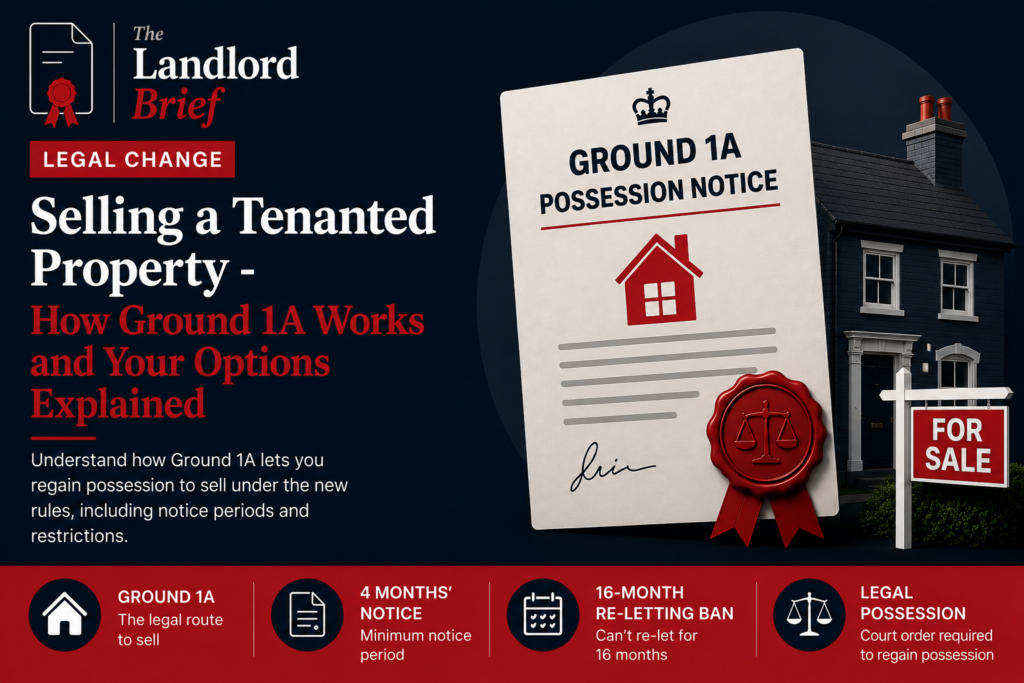
Published: May 2026 | Reading time: 8 minutes | Category: Renters’ Rights Act
Selling a tenanted property in England is more complicated than it used to be, and the mathematics of doing it have changed significantly.
Section 21 is abolished. The mechanism that allowed landlords to recover possession without a stated reason is gone. In its place, landlords who want vacant possession before selling have one route: Ground 1A under Section 8. It works, but it is slower, riskier, and more expensive than Section 21 ever was.
Selling with the tenant in place is the alternative, and for many landlords it will be the smarter choice. This article covers both routes: what each involves, what each costs, what the risks are, and how to choose the right one for your situation.
If you need the full plain-English overview of the Act before diving into the selling decision, see: The Renters’ Rights Act – The Complete Plain-English Guide for Landlords
Key takeaways (read this first)
- You have two routes: Vacant possession via Ground 1A, or selling with the tenant in situ. Neither route is always the right choice – the best option depends on your buyer pool, timeline, property type and financial position.
- Ground 1A – 4 months’ notice, after 12 months: You cannot use Ground 1A in the first 12 months of a tenancy. The 12-month clock runs from the original tenancy start date, not from 1 May 2026. You can serve notice after 8 months so that it expires at the 12-month mark.
- The re-letting restriction runs from the notice date: Once you serve a Ground 1A notice, you cannot re-let or market the property for letting for at least 16 months from that date, whether or not the sale completes.
- Re-letting during the restricted period is a criminal offence: The penalty is a civil fine of up to £40,000, not the standard £7,000 threshold. Courts treat misuse of Ground 1A seriously.
- If your sale falls through, you are stuck: The re-letting ban runs regardless of whether you sell. If no buyer is found, you could be left with a vacant property, no rental income and ongoing mortgage costs for months. This risk is underreported.
- Evidence is mandatory, not optional: Ground 1A is mandatory (the court must grant possession if the ground is made out), but you must prove genuine intent to sell. Keep your estate agent instructions, correspondence, and any sale agreements.
- Selling with tenants in situ is often financially competitive: Investor buyers pay 5-15% less than owner-occupiers, but you keep receiving rent through to completion and avoid the cost and time of Ground 1A proceedings.
- Your compliance paperwork is the sale’s weakest link: Buyer’s solicitors will demand a full paper trail: gas safety certificates, deposit protection, EPC, EICR and prescribed information receipts. Missing documents can and do collapse sales.
Important: This article covers England only
The Renters’ Rights Act applies to England only. Ground 1A is an England-only possession ground. Scotland, Wales and Northern Ireland have separate frameworks. If you let property outside England, the rules are different.
Part 1 - Your Two Routes: The Decision Frame
Before you can plan a sale, you need to decide which route you are taking. The decision depends on four things: your buyer pool, your timeline, your property type, and your appetite for the Ground 1A process.
Vacant possession (Ground 1A)
Vacant possession (Ground 1A)
Selling with tenant in situ
Buyer pool
Full market, owner-occupiers and investors. Maximum buyer competition.
Investors only. Limited competition, but a motivated buyer base.
Price expectation
Market value. Owner-occupiers typically pay more than investors.
Typically 5–15% below vacant equivalent. Gap is smaller in high-demand markets.
Timeline
Minimum 4 months’ notice, then court proceedings if contested (add 6-9 months). Total realistic timeline from decision to vacant possession: 6-18 months.
Same as any property sale, typically 3-6 months from listing to completion.
Risk
High. The re-letting restriction runs from the notice date regardless of whether the sale completes. You carry the property empty if the sale stalls.
Lower. Rental income continues until completion. No Ground 1A process required.
Evidence required.
Yes, genuine intent to sell must be demonstrated to the court.
Full compliance paper trail for buyer’s solicitor – see Part 5.
Rental income during sale
None after possession date
Yes, until the day of completion.
Best suited to
Properties in high owner-occupier demand areas. Landlords with financial headroom to carry vacancy.
Investment-heavy markets. Properties with reliable tenants on good yields. Landlords who want a clean exit without eviction proceedings.
Part 2 - Route 1: Vacant Possession via Ground 1A
What Ground 1A is
Ground 1A is a mandatory possession ground introduced by the Renters’ Rights Act. It allows a landlord to recover possession of a property they genuinely intend to sell. Because it is a mandatory ground, a court must grant possession if the ground is made out, there is no judicial discretion to refuse on grounds of hardship or reasonableness. But mandatory does not mean automatic: you must still prove the ground, and the court will scrutinise whether the intention to sell is genuine.
The notice requirements:
Requirement
Detail
Notice form
Form 3A, the Section 8 notice form from 1st May 2026 (available from gov.uk). Do not use the old Form 3.
Notice period
4 months minimum.
When you can serve
Not before 8 months into the tenancy. The notice must not expire until after the first 12 months of the tenancy.
The 12-month clock
Runs from the original tenancy start date, not from 1 May 2026. A tenancy that started in October 2024 has already passed its 12-month mark. A tenancy that started in March 2026 must run to March 2027 before a Ground 1A notice can expire.
How to serve
In person, recorded post, or email (if the tenancy agreement provides for electronic service). Keep proof of every method.
Evidence of intent to sell
Not prescribed by the Act, but the burden of proof lies with you. Keep estate agent instructions, sale agreements, and any written evidence of the decision to sell. A court will refuse possession if it concludes the ground has not been made out.
Shared ownership
Shared ownership leaseholders who can demonstrate genuine attempts to sell may be exempt from the re-letting restriction. Specific criteria apply, including a notification requirement to the tenant by 31st May 2026 for pre-commencement tenancies. Take legal advice if this affects you.
After possession – the re-letting restriction
Once you have served a Ground 1A notice, you cannot re-let or market the property for letting, including short-term lettings such as Airbnb, for 12 months from the date the notice period expires.
In a standard uncontested case where the notice runs its full 4-month period, this means the restriction effectively runs for approximately 16 months from the date you served the notice. Where court proceedings are issued, the restricted period extends to 12 months from the later of the notice expiry date or the date proceedings begin.
RE-LETTING DURING THE RESTRICTED PERIOD IS A CRIMINAL OFFENCE
The penalty is a civil fine of up to £40,000, substantially higher than the standard £7,000 threshold for general non-compliance. The local council can prosecute. Your letting agent has no defence unless they can prove they took all reasonable steps to avoid the breach. Misuse of Ground 1A can also trigger a Rent Repayment Order requiring you to repay up to two years’ rent to the former tenant.
There is no “it was an honest mistake” defence. Re-letting during a period when re-letting is explicitly a criminal offence is treated seriously by courts and councils alike.
The restriction does not apply if the property has been demonstrably on the open market at a fair price and no suitable offer has been received, representing a genuine failure to sell. The exact criteria for this exception are not exhaustively defined in accessible guidance. If you are relying on this exception, take legal advice before re-letting. The restriction also does not prevent you from allowing an intending purchaser to move in on a licence ahead of completion.
Part 3 - The Risks of Ground 1A That Most Guides Miss
The sale falls through – and you cannot re-let
This is the scenario that most landlord guides gloss over, and it is the most serious financial risk of the Ground 1A route. Once you have served a Ground 1A notice, the re-letting restriction runs regardless of whether the sale completes. If your buyer pulls out, if the chain collapses, if the property fails to sell at your asking price and you decide to wait, you cannot put a new tenant in during the restricted period. You are carrying an empty property, with ongoing mortgage payments, council tax, and utility costs, for months.
The practical financial exposure: if your property generates £1,000 per month in rent and sits empty for 6 months during a stalled sale, that is £6,000 in lost income on top of your ongoing costs. For many landlords, the mathematics of Ground 1A only work if the sale completes quickly and at close to asking price.
BEFORE SERVING A GROUND 1A NOTICE - ASK YOURSELF THESE QUESTIONS
- Is my decision to sell firm, or might circumstances change? If there is any chance you will want to continue letting if the sale does not go through, Ground 1A is the wrong route.
- Can I carry the property empty for up to 16 months if needed? Do you have financial headroom to cover mortgage, council tax, and costs without rental income?
- Is my tenant likely to leave voluntarily on notice, or will I need to go to court? A contested Ground 1A claim adds 6-9 months to the timeline, and your restricted period keeps running regardless.
- Have I instructed an estate agent? You will need to demonstrate genuine intent to sell to the court. If you have not yet put the property on the market, have a clear plan and timeline before you serve notice.
Misuse of Ground 1A carries serious consequences
Using Ground 1A and then re-letting within the restricted period, whether because the sale fell through or because you decided not to sell after all, is a criminal offence and can trigger a civil penalty of up to £40,000, plus a Rent Repayment Order of up to two years’ rent. Courts treat Ground 1A misuse seriously. There is no honest mistake defence for re-letting during a period when re-letting is explicitly a criminal offence.
See: Section 8 Explained for the full context on misuse penalties.
Part 4 - Route 2: Selling With the Tenant in Place
Why this route is more competitive than most landlords assume
The instinct of most landlords planning a sale is to recover possession first. The assumption is that a vacant property achieves a better price. That is true, but the gap is smaller than many landlords expect, and when you factor in the cost and time of the Ground 1A process, selling with a tenant in place often produces a better net outcome.
Suppose your property is worth £250,000 vacant. An investor buyer might pay £215,000–£237,500 for it tenanted (a 5–15% discount). Ground 1A proceedings that take 8 months will cost you 8 months of mortgage payments without rental income, plus legal costs and court fees. For many properties, the net difference between the two routes is smaller than it appears, and occasionally in favour of the tenanted sale.
The case for selling with the tenant in place is strongest when: your tenant is reliable and the yield is good (investors value this); your property is in an area with strong rental demand; and your tenant is willing to cooperate with viewings.
What happens to the tenancy when you sell
The tenancy transfers to the buyer automatically on completion. Your buyer becomes the new landlord. The tenant’s rights are unchanged, they have the same tenancy, the same rent, and the same protections. No new agreement needs to be signed. The buyer steps into your shoes on the day of completion. For a full breakdown of how tenancies automatically converted on 1 May 2026 and what terms changed, see: Your Tenancy Agreement Has Changed – A Complete Guide for England Landlords
You are not legally required to tell the tenant you are selling, but in practice most solicitors recommend you do. A cooperative tenant who allows viewings at reasonable notice and keeps the property presentable is a significant asset in the sale process. Consider whether a small goodwill gesture, such as a month’s reduced rent, is worth the cooperation it buys.
Tenant rights during the sale process
Your tenant’s rights do not change because the property is being sold. They have a right to quiet enjoyment. You and your agent cannot access the property without 24 hours’ minimum written notice, and viewing arrangements should be agreed with the tenant in advance. Excessive or inconvenient viewing access that causes material disruption to the tenant’s life can be challenged as a breach of the tenancy or, in extreme cases, as harassment.
Your tenant also has the right to remain in the property if the sale completes, they cannot be evicted simply because there is a new landlord. If the buyer intends to occupy the property themselves, they will need to use Ground 1 (moving in) after completion, following the same rules as any other landlord.
Deposit transfer – your completion day obligation
When the sale completes, you must transfer the tenant’s deposit to the new landlord. The new landlord must then re-protect it in their own chosen scheme within 30 days and serve updated Prescribed Information on the tenant. Failure to handle the deposit transfer correctly creates liability for both parties.
Your solicitor should handle this as part of the conveyancing process, but confirm it explicitly. Rent apportionment also needs to be calculated at completion: if your tenant pays rent on the 1st of the month and you complete on the 15th, the buyer is entitled to half that month’s rent, and your solicitor will account for this in the completion statement.
Part 5 - The Compliance Paper Trail Your Buyer's Solicitor Will Demand
This section applies to both routes, but it is especially critical if you are selling with the tenant in place. Buyer’s solicitors in 2026 are thorough about this. A significant proportion of tenanted sales hit delays or collapse because the landlord simply cannot produce the paperwork. “I have always done it right” is not a substitute for a file of documents.
DOCUMENTS YOUR BUYER'S SOLICITOR WILL REQUEST
- Tenancy agreement: Signed copy of the current tenancy agreement. If the tenancy converted on 1st May 2026, the original written AST is the document – no new agreement is needed, but you need the original signed copy.
- Gas Safety Certificate: Current certificate plus a complete history. Buyer’s solicitors often request the full history to confirm the obligation has been met throughout the tenancy.
- EICR (Electrical Installation Condition Report): Must be current — within 5 years of the last inspection. A satisfactory report only. If the current report is unsatisfactory, remedial works must have been completed and signed off before a new certificate can be issued.
- EPC (Energy Performance Certificate): Current and valid (within 10 years). Property must be rated E or above. An F or G rating is an active compliance problem – deal with it before listing.
- Deposit protection certificate: Evidence that the deposit is currently protected in a government-approved scheme. Include the scheme reference number. The buyer will need this to arrange transfer on completion.
- Deposit Prescribed Information receipt: Evidence that you served the Prescribed Information on the tenant within 30 days of receiving the deposit. A signed receipt or dated email is sufficient. Without this, you are exposed to a penalty of 1-3 times the deposit amount.
- How to Rent guide: Confirmation that you provided the current version at the start of the tenancy. A signed acknowledgement from the tenant is best practice.
- Government Information Sheet (for conversions): If the tenancy converted on 1st May 2026, evidence that you served the Information Sheet on the tenant by 31st May 2026.
- Smoke and carbon monoxide alarm test record: Written record of testing at the start of the tenancy. A brief contemporaneous note or signed checklist is sufficient.
- Any notices served: Copies of any notices served on the tenant during the tenancy – rent increase notices, breach notices, or any Section 8 notices. Include proof of service for each.
- Rent payment record: A clear ledger of rent payments received and any arrears. Buyers will want to see payment history as part of their assessment of the tenancy.
For the full compliance checklist covering all your landlord obligations beyond the sale, see: The England Landlord Compliance Checklist.
DO NOT WAIT FOR THE BUYER'S SOLICITOR TO FIND A GAP
The most common cause of sale delays and abortive transactions in tenanted property sales is compliance documentation that the landlord assumed existed but cannot locate. Gas safety histories, deposit protection records, Prescribed Information receipts, which are easy to produce at the time but difficult to reconstruct years later. Run through the checklist above before you instruct an estate agent or solicitor. Know what you have and what you cannot find. The sooner you know, the sooner you can take action.
SECTION 21 TRANSITIONAL WINDOW - HISTORICAL CONTEXT
This section applies only if you had a valid Section 21 notice served before 1 May 2026 and issued court proceedings by 31st July 2026.
Section 21 notices served before 1st May 2026 remained valid under the transitional provisions, but only if court possession proceedings were begun by 31 July 2026. That deadline has now passed.
If you are reading this after 31st July 2026: the transitional window is closed. Ground 1A is now your only route to vacant possession before selling. If you had an outstanding Section 21 notice and did not issue proceedings in time, that notice has lapsed. See the official guidance at gov.uk/government/publications/guide-to-the-renters-rights-act for the full transitional rules.
IF YOU ARE PURSUING VACANT POSSESSION VIA GROUND 1A - DO THESE IN ORDER
- Confirm your decision to sell is firm before you serve any notice. Once the Ground 1A notice is served, the re-letting restriction runs, even if the sale falls through. Make sure you can carry the property empty for up to 16 months if needed.
- Check when your tenancy started. The 12-month clock runs from the original tenancy start date – it did not reset on 1st May 2026. If your tenancy started more than 12 months ago, Ground 1A is available to you now (subject to the 4-month notice period). If it started within the last 12 months, calculate your earliest valid notice expiry date.
- Run through the compliance paper trail checklist (Part 5) now, before you instruct your estate agent or solicitor. Your buyer’s solicitor will request every document on that list. Identify and resolve any gaps before you are in a live transaction.
- Instruct a specialist landlord solicitor to draft and serve the Form 3A notice. Ground 1A is mandatory but not automatic – the notice must be correctly served and the ground properly stated. A defective notice is a wasted 4 months.
- Assemble your evidence of genuine intent to sell: estate agent instructions, correspondence with agents, any valuation reports. Keep this in a file, a judge may require you to demonstrate that the ground is made out.
- Serve the notice correctly: in person, recorded post, or by email if permitted under the tenancy agreement. Keep dated proof of every method of service. The notice is invalid if it cannot be proved to have been received.
- If the tenant does not leave at the notice expiry date, issue Section 8 court proceedings promptly. Do not delay – the clock on the restricted period is running and a contested claim currently takes 6-9 months to resolve.
- Do not market the property for re-letting or accept any new tenants during the restricted period. This includes Airbnb and other short-term licences. Breaching this is a criminal offence carrying a fine of up to £40,000, not the standard £7,000 threshold.
IF YOU ARE SELLING WITH THE TENANT IN PLACE - DO THESE IN ORDER
- Run through the compliance paper trail checklist (Part 5) before instructing an estate agent. Identify any missing documents now. Once you are in a live sale transaction is the wrong time to discover a gap.
- Instruct a specialist buy-to-let estate agent or auction house with experience of tenanted sales. Not all estate agents are comfortable managing tenant access and vendor compliance requirements simultaneously.
- Tell the tenant early and clearly. You are not legally required to, but a cooperative tenant is a commercial asset. Explain what the process looks like, what access you will need to arrange, and that their tenancy continues after the sale.
- Agree viewing arrangements with the tenant in writing – specific time slots, minimum notice, and any compensation offered for cooperation. Keep a record of the agreed arrangements.
- Confirm the deposit transfer process with your solicitor before exchange of contracts. The deposit must transfer to the buyer’s protection scheme on or before completion. Agree who is responsible for notifying the tenant.
- Agree rent apportionment at completion. If the tenant pays rent on the 1st of the month and you complete on the 15th, the buyer is entitled to half that month’s rent. Your solicitor will handle this but confirm it is in the completion statement.
- Ensure the tenancy agreement is included in the legal pack your solicitor sends to the buyer. The buyer’s solicitor will also need every document in the Part 5 compliance checklist – prepare the full pack proactively rather than responding to requests.
Frequently Asked Questions About Ground 1A and Selling a Tenanted Property
Can I sell a property with tenants still living there?
Yes. The tenancy transfers automatically to the buyer on completion and continues on the same terms.
Do I have to use Ground 1A before selling?
No. Ground 1A is only required if you want vacant possession before the sale completes.
Can I serve a Ground 1A notice immediately after granting a tenancy?
No. A Ground 1A notice cannot expire within the first 12 months of the tenancy.
What happens if my sale falls through after using Ground 1A?
The re-letting restrictions may still apply, meaning you could be unable to immediately re-let the property.
Will a buyer pay less for a tenanted property?
Often yes, but the discount can be smaller than the cost of obtaining vacant possession.
Get the Complete Landlord Compliance Toolkit
The 2026 Landlord Compliance Toolkit includes the complete Section 8 grounds reference guide, including Ground 1A notice requirements and the re-letting restriction rules, plus the full compliance paper trail checklist for tenanted property sales.
- 40-point compliance checklist
- Information sheet delivery log
- Section 8 quick reference guide
- Rent increase letter template
- Pet request response templates
- Key landlord deadlines calendar
Instant access. Download and use today.
A NOTE ON THIS ARTICLE
This article is guidance only and not formal legal advice. The Landlord Brief aims to translate complex legislation into plain English — but every landlord’s situation is different.
If you have tenants in rent arrears, a possession case in progress, or a complex tenancy arrangement, we strongly recommend speaking to a specialist landlord solicitor before acting.